
How to Make a Small Room Look Bigger: Simple Design Ideas That Work
Small rooms have a charm of their own. They can feel cozy, welcoming, and full of character. But when furniture crowds the floor, natural light is limited, or storage becomes a challenge, even a lovely room can start to feel cramped.
The good news is that making a small room look bigger doesn’t necessarily require knocking down walls or investing in an expensive renovation. A few thoughtful design choices can change how you experience a space, making it feel brighter, more open, and easier to live in.
From choosing the right colors to arranging furniture more carefully, these practical ideas can help you make the most of every square foot.
Let Natural Light Do the Work
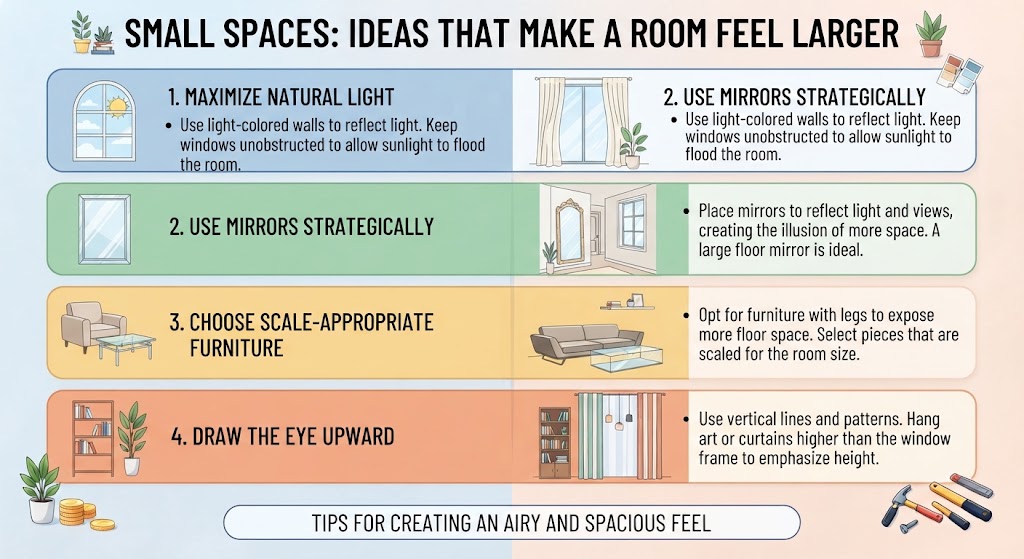
Natural light is one of the simplest ways to make a small room feel more spacious. Bright rooms tend to feel more open, while dark corners and heavy window treatments can make a space appear smaller than it really is.
Start by keeping windows as clear as possible. Replace heavy curtains with lightweight fabrics that allow daylight to filter through, or consider simple blinds that can be fully opened during the day.
Mirrors can also make a noticeable difference. Placing a mirror opposite or beside a window helps reflect incoming light and creates a greater sense of depth. A large mirror can work particularly well in a narrow living room, a small bedroom, or an entryway.
Don’t overlook artificial lighting, either. When daylight fades, a single overhead fixture may leave parts of the room feeling dark. Instead, combine different sources of light, such as floor lamps, table lamps, and wall lights. Illuminating several areas helps reduce harsh shadows and makes the room feel more balanced.
Design tip: Choose light fixtures that provide enough illumination without taking up valuable floor or table space. Wall-mounted lights are particularly useful in compact rooms.
Choose Colors That Create a Sense of Space
Color influences how large or small a room appears. Light, soft shades can help walls feel less imposing, especially when combined with good lighting and an uncluttered layout.
Warm whites, pale beige, soft gray, and muted earth tones are popular choices because they create a calm backdrop for furniture and accessories. You don’t have to paint every surface white to achieve an open feeling.
One useful technique is to keep the walls, trim, and ceiling within a similar color family. When there is less visual contrast between these surfaces, the boundaries of the room can feel less pronounced.
That said, dark colors are not automatically a mistake in small spaces. Deep green, navy, charcoal, and other rich shades can create a sophisticated, intimate atmosphere. Used thoughtfully, they can make a small room feel intentional rather than cramped.
The key is to consider the amount of natural light, the room’s proportions, and the overall design. If you’re unsure, test paint samples on different walls and observe how they look throughout the day.
Show More of the Floor
The more floor you can see, the more open a room may feel. Furniture that sits directly on the ground can create a heavier appearance, especially when several large pieces are grouped together.
Consider sofas, chairs, and cabinets with raised legs. These designs allow you to see beneath the furniture, creating a lighter visual effect without sacrificing comfort.
A carefully chosen area rug can also help define a space. In a small living room, a rug large enough to connect the main seating pieces often looks more cohesive than several small rugs scattered around the floor.
Try to avoid placing too many furniture pieces in the main walking paths. Clear routes through the room make movement easier and prevent the layout from feeling crowded.
If you’re buying new furniture, measure the room before making a purchase. A piece that looks perfectly proportioned in a showroom may overwhelm a smaller space at home.
Draw the Eye Upward
When floor space is limited, look to the walls and ceiling for opportunities to create a greater sense of height.
One of the easiest tricks is to hang curtains higher than the top of the window frame, ideally closer to the ceiling when the room’s proportions allow it. Longer curtains that reach the floor can emphasize vertical lines and make windows appear taller.
Tall shelving, vertical artwork, and narrow bookcases can achieve a similar effect. They draw attention upward while providing useful storage or display space.
You can also use wall-mounted shelves to free up floor space. Rather than adding another cabinet, consider whether books, decorative objects, or everyday essentials could be stored neatly on the wall.
Be selective, however. Filling every available wall with shelves and decorations can create visual clutter. A few well-placed vertical elements are often more effective than covering the entire room.
Choose Furniture That Fits the Room
Furniture has a major influence on how spacious a room feels. The goal isn’t simply to buy smaller pieces; it’s to choose furniture that suits the room’s proportions and serves a clear purpose.
Look for Multifunctional Pieces
In a compact room, furniture that performs more than one job can be particularly useful.
Consider an ottoman with hidden storage, a bench with shelves underneath, a nesting table set, or a dining table that folds away when it’s not needed. A sofa bed may also be practical in a room that occasionally serves as a guest bedroom.
These pieces reduce the need for additional furniture, leaving more room to move around.
Avoid Too Many Small Pieces
It may seem logical to fill a small room with small furniture, but too many individual pieces can make the space feel busy.
Instead, consider a few appropriately scaled items that work well together. A properly sized sofa, a compact side table, and one well-positioned lamp may create a more comfortable arrangement than numerous small tables and chairs.
Before buying anything, identify the essential activities the room needs to support. A living room used mainly for relaxing may need a different arrangement from one that also serves as a home office.
Choose Visually Light Designs
Furniture doesn’t have to be physically small to feel light. Pieces with slim frames, open bases, glass surfaces, or simple silhouettes allow the eye to move through the room.
For example, a glass coffee table can provide a useful surface without creating the same visual weight as a bulky wooden table. An open-frame chair may feel less imposing than a large upholstered armchair.
Use these features selectively. Comfort, durability, and practicality still matter, particularly if the room is used every day.
Reduce Clutter Without Losing Personality
One of the most effective ways to make a small room feel larger costs nothing at all: remove the things you don’t need.
Clutter occupies physical space, but it also creates visual noise. When every surface holds decorations, papers, accessories, or everyday objects, the room can feel crowded even if there is plenty of floor space.
Start by clearing countertops, coffee tables, and other prominent surfaces. Keep the items you use regularly within easy reach, and find designated storage for everything else.
Baskets, closed cabinets, drawer organizers, and storage furniture can help keep belongings out of sight. In a bedroom, under-bed storage may provide extra capacity without requiring another wardrobe.
You don’t need to eliminate every decorative object. Books, plants, artwork, and personal collections give a room character. The aim is to display them intentionally rather than allowing them to compete for attention.
Leave some empty space on shelves and walls. These visual breaks help the objects you choose to display stand out.
Add One Strong Focal Point
A small room doesn’t have to be plain to feel spacious. In fact, a carefully chosen statement piece can give the space personality and help it feel more thoughtfully designed.
A striking piece of artwork, an attractive pendant light, a colorful accent chair, or an interesting patterned cushion can create a clear focal point.
The important thing is to avoid competing focal points. If every wall has a bold pattern and every surface holds a decorative object, the room can feel visually overwhelming.
Choose one main feature and let the surrounding elements support it. For example, a large piece of artwork above a sofa can provide enough visual interest without requiring an elaborate gallery wall, multiple accent colors, and several decorative accessories.
This approach allows you to express your style while keeping the overall room calm and cohesive.
Make Storage Part of the Design
Storage problems often make small rooms feel smaller. When belongings have no designated place, they accumulate on floors, chairs, and countertops.
The solution is to plan storage around the way you actually use the room.
In a bedroom, consider a bed with drawers or a wardrobe that makes efficient use of vertical space. In a living room, a storage ottoman or a cabinet with closed doors can keep everyday items organized. In a narrow entryway, wall hooks and a slim shoe cabinet may provide everything you need without obstructing the walkway.
Built-in storage can be useful where space is particularly limited, but it isn’t always necessary. Before investing in custom cabinetry, look at the furniture and storage solutions already available.
The best storage is easy to access, appropriately sized, and simple to maintain. If putting something away requires too much effort, clutter is likely to return.
Keep Patterns and Textures in Balance
Patterns can add depth and character to a small room, but too many competing designs can make the space feel busy.
If you enjoy patterned wallpaper, colorful textiles, or decorative tiles, choose one or two elements to lead the design. Balance them with simpler surfaces and complementary colors.
Vertical stripes can emphasize height, while carefully placed horizontal elements may make a narrow space feel wider. However, these effects depend on the room’s proportions and the scale of the pattern.
Texture can also add interest without overwhelming the room. Linen curtains, a woven rug, natural wood, and soft upholstery can create depth while maintaining a restrained color palette.
Rather than avoiding decoration altogether, think about how each element contributes to the overall composition.
Don’t Forget the Layout
Even the right colors and furniture can fail to make a room feel spacious if the layout is awkward.
Start by identifying the main function of the room and arranging the furniture around it. In a living room, that might mean positioning seating around a conversation area. In a bedroom, it could mean keeping the route from the door to the bed clear.
Avoid blocking windows, doorways, and natural walking paths. If furniture makes it difficult to move comfortably through the room, try rearranging the existing pieces before purchasing anything new.
It can help to sketch the layout or measure the furniture and mark its approximate position on the floor. This simple step allows you to experiment with different arrangements without repeatedly moving heavy items.
Remember that a room doesn’t need to be filled to feel complete. Leaving some space unused can improve circulation and make the entire room more comfortable.
Small Rooms, Better Design
Making a small room look bigger is less about following strict rules and more about making deliberate choices. Light, color, furniture proportions, storage, and layout all influence how a space feels.
Start with the simplest changes: open the curtains, clear the surfaces, improve the lighting, and rearrange the furniture. Then consider whether a mirror, a different rug, or a more practical storage solution would make a meaningful difference.
You don’t need a large budget or a major renovation to create a room that feels open and welcoming. With a little planning, even a compact space can feel comfortable, functional, and full of character.
If you’re working with limited space in another part of the home, explore our guide to small kitchen layouts for practical ideas on making every inch count.

Comments
0 commentsNo comments yet. Be the first to share your experience.