
How to Finance a Home Remodel: Understanding Your Options
Planning a home remodel is exciting. You get to imagine a more functional kitchen, a more comfortable living space, or a bathroom that finally feels the way you want it to. Figuring out how to pay for those improvements, however, is often less enjoyable.
The good news is that financing a remodeling project doesn’t have to be complicated. There are several ways to cover the cost, and understanding how they compare can help you make a decision that fits your budget, your timeline, and your long-term financial goals.
Before choosing a financing option, take a step back and look at the full cost of the project. Include labor, materials, permits, and any additional expenses that might come up along the way. A clear budget gives you a more realistic picture of how much money you’ll need and whether borrowing makes sense.
Please note: This article is for general informational purposes only and does not constitute financial advice. Consider consulting a qualified financial professional or lender about your individual circumstances.
The Most Common Ways to Finance a Remodel
There is no single financing option that works for every homeowner. The right choice depends on the size of the project, the funds you already have available, and how comfortably you can manage future payments.
1. Use Your Savings
If you have enough money set aside, paying for your remodel with savings is often the most straightforward approach. You avoid interest charges, loan applications, and monthly debt payments.
Using cash can also give you greater flexibility throughout the project. You won’t have to account for a new loan payment when planning your household expenses.
However, it is important to consider how much of your savings you would be using. Spending your entire emergency fund on a renovation can leave you financially exposed if an unexpected expense arises. Before committing, make sure you can cover the project without sacrificing the financial cushion you may need for other priorities.
Best for: Homeowners with sufficient savings who want to avoid borrowing and can still maintain an emergency reserve.
2. Consider a Home Equity Loan or Line of Credit
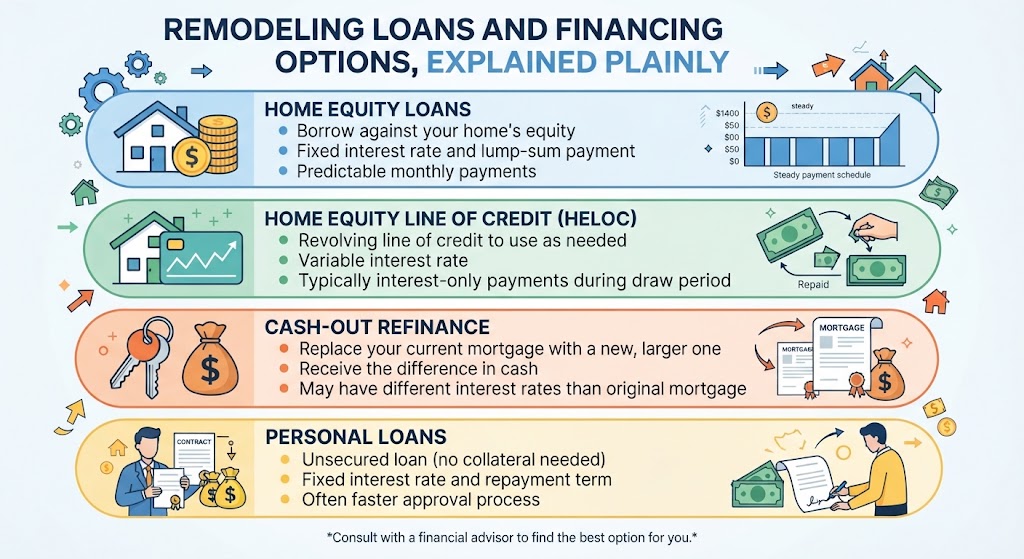
If you have built up equity in your home, you may be able to borrow against it to fund your remodeling project. Two common options are a home equity loan and a home equity line of credit, often called a HELOC.
A home equity loan generally provides a lump sum that you repay over an agreed period. It may be useful when you have a reasonably accurate estimate of your total remodeling costs and prefer predictable payments.
A HELOC works more like a revolving credit line. You can draw money as needed, subject to the lender’s terms and the available credit limit. This flexibility can be helpful when a project unfolds in stages or expenses arise at different times.
Both options have important considerations. Interest rates, fees, repayment terms, and eligibility requirements vary by lender. Most importantly, your home serves as collateral. If you cannot meet the repayment obligations, you could risk losing your property.
Best for: Homeowners with sufficient equity who understand the risks and need financing for a substantial project.
3. Look Into a Personal Loan
A personal loan may be another way to finance a remodel without using your home as collateral. Depending on the lender, you may be able to borrow a set amount and repay it through regular monthly installments.
The application process can be relatively straightforward, and some lenders offer fixed interest rates that make monthly payments easier to plan. Unlike home equity financing, a typical unsecured personal loan does not directly use your property as collateral.
The trade-off is that interest rates can be higher than those available on certain home-secured loans. Your credit history, income, loan amount, and repayment term may all influence the offer you receive.
Before accepting a loan, compare the annual percentage rate (APR), which can include certain fees as well as interest, and calculate the total amount you will repay over the life of the loan.
Best for: Homeowners who need a defined amount of funding and prefer not to secure the loan against their home.
4. Use a Credit Card Carefully
Credit cards can be convenient for smaller remodeling expenses, such as light fixtures, paint, hardware, or other individual purchases. They may also provide purchase protections or rewards, depending on the card.
Some cards offer introductory promotional interest rates, which can make short-term financing attractive if you understand the conditions and can repay the balance before the promotional period ends.
The main concern is the cost of carrying a balance. Standard credit card interest rates can be high, and a large balance can become expensive if repayment takes longer than expected. Promotional offers may also have specific conditions that are important to understand before you use them.
For a major renovation, relying heavily on credit cards can put unnecessary pressure on your monthly budget. If you choose this route, have a realistic repayment plan before making the purchases.
Best for: Smaller expenses that you can repay promptly, rather than large projects that require long-term financing.
5. Compare Contractor and Retailer Financing Offers
Some remodeling contractors, home improvement retailers, and their financing partners offer payment plans or promotional financing. These arrangements can make it easier to coordinate purchases and payments, particularly when buying materials or appliances.
However, convenience should not be the only factor in your decision. Look closely at the interest rate, fees, repayment period, and conditions attached to any promotional offer. A plan advertised with no interest, for example, may require you to pay the entire balance within a specified period to avoid additional interest charges.
It is also worth comparing the financing offer with an independent loan. A convenient payment plan is not necessarily the least expensive option, and the terms can vary considerably between providers.
Best for: Homeowners who want a convenient payment arrangement and can verify that the financing terms are competitive.
6. Explore Renovation Mortgage Options
For certain homeowners, a renovation mortgage may be worth investigating. These mortgage products can combine home purchase or refinancing costs with funding for eligible improvements, depending on the program and lender.
They may be particularly relevant if you are buying a property that needs significant work or planning a major renovation alongside a mortgage refinance.
Renovation mortgages typically involve additional requirements. The lender may need to approve the planned work, review contractor estimates, and establish how renovation funds will be released. Closing costs, eligibility rules, and project restrictions can also affect whether this approach makes sense.
Because these products are designed for specific circumstances, ask a lender to explain the available programs and how their costs compare with other financing methods.
Best for: Homebuyers and existing homeowners undertaking substantial renovations who meet the requirements of a suitable mortgage program.
Questions to Ask Before Choosing a Lender
Once you have identified a few possible financing options, compare the actual terms rather than focusing only on the advertised interest rate. A loan with a lower rate may still cost more if it includes substantial fees or a longer repayment period.
Before signing an agreement, ask the lender the following questions:
-
What is the APR? Compare the annual percentage rate, not just the advertised interest rate, to get a clearer picture of borrowing costs.
-
Is the interest rate fixed or variable? A fixed rate generally provides more predictable payments, while a variable rate may change over time.
-
How long is the repayment term? A longer term can reduce monthly payments but may increase the total interest you pay.
-
Are there application, closing, or other fees? Find out about upfront charges and any ongoing costs.
-
Are there penalties for early repayment? Check whether paying off the loan ahead of schedule could trigger additional fees.
-
What happens if I miss a payment? Understand late fees, credit consequences, and the lender’s collection procedures.
-
Is my home being used as collateral? Make sure you understand the risks before securing debt against your property.
-
What is the total repayment amount? Ask for an estimate of the principal, interest, and applicable fees over the full term.
Taking the time to answer these questions can help you compare offers on equal terms and avoid surprises after the remodeling work begins.
Don’t Forget to Budget for the Unexpected
Even a carefully planned remodeling project can uncover problems once work starts. A contractor might discover damaged plumbing, outdated wiring, hidden water damage, or other issues that need attention before the renovation can continue.
That is why your financing plan should account for more than the original estimate. Alongside labor and materials, set aside a contingency reserve for unexpected costs. The appropriate amount depends on the age of the property, the complexity of the work, and how much uncertainty remains in the project.
It is also wise to consider the timing of payments. Contractor deposits, material orders, and progress payments may fall due at different stages, so make sure the money will be available when it is needed.
For more guidance, see our article on [remodeling contingency planning] and learn how to prepare for unexpected expenses without losing control of your budget.
Choose Financing That Fits Your Bigger Financial Picture
The best way to finance a remodel is not necessarily the option that provides the largest loan or the lowest initial monthly payment. It is the one that allows you to complete the work while keeping your overall finances manageable.
Start by establishing a realistic project budget, including a reserve for unexpected expenses. Then compare the money you can comfortably contribute from savings with the cost and risks of borrowing. If you need a loan, review several offers and consider both the monthly payment and the total repayment amount.
Most importantly, resist the pressure to make a quick decision. Take time to read the terms, ask questions, and understand what you are committing to before signing an agreement.
A well-planned remodel should improve your home without creating unnecessary financial stress. With a clear budget and a careful comparison of your options, you can approach the project with greater confidence and make decisions that work for both your home and your future.

Comments
0 commentsNo comments yet. Be the first to share your experience.